Why the Modern 4-Step Business Infographic Template Is Reshaping Visual Communication for Today’s Professionals
In an era where attention spans shrink and information overload intensifies, clarity isn’t just preferred—it’s non-negotiable. Whether you're pitching a startup idea to investors, onboarding remote team members, launching a SaaS product, or simplifying complex service workflows for clients, how you communicate matters as much as what you say. Enter the Modern 4-Step Business Infographic Template: not just another design asset, but a strategic tool engineered for precision, adaptability, and impact across evolving professional landscapes.
A Template Built for Purpose—Not Just Aesthetics
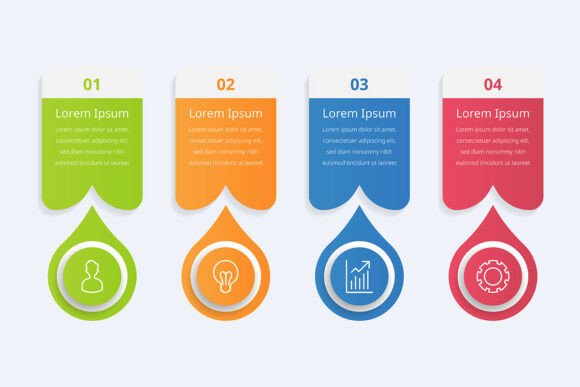
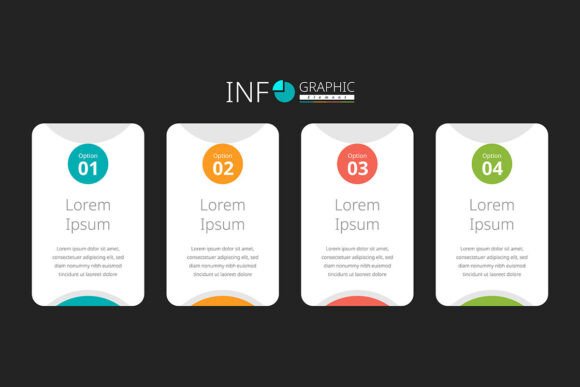
The Modern 4-Step Business Infographic Template is a rigorously structured visual framework designed around the cognitive principle that humans process sequential, goal-oriented information most effectively in digestible, narrative-driven stages. Unlike generic infographic layouts, this template distills business processes—such as customer journey mapping, product onboarding, value proposition articulation, or operational workflows—into four intentional, scalable steps. Each stage is spatially balanced, typographically harmonized, and visually distinct, enabling immediate comprehension without sacrificing sophistication.
What sets it apart isn’t just its clean aesthetic—it’s its functional intelligence. Every element is fully editable, meaning marketers can swap icons, adjust color schemes to match brand guidelines, rewrite step labels in seconds, and reposition supporting visuals—all within familiar tools like Adobe Illustrator or Photoshop. The inclusion of high-resolution files, ready to use, eliminates the friction of scaling or repurposing: whether embedded in a pitch deck, exported for social media, or printed for conference handouts, fidelity remains uncompromised.
Delivered in both EPS and JPEG formats and built in RGB color mode, the template bridges creative flexibility with technical readiness—supporting digital-first workflows while maintaining compatibility across platforms, CMS integrations, and collaborative design environments.
Aligning With Broader Shifts in Professional Communication
This template doesn’t exist in isolation. It reflects—and accelerates—several converging trends reshaping how professionals create, share, and act on information.
1. The Rise of Visual Literacy as a Core Competency
According to recent studies by the Content Marketing Institute and LinkedIn Workplace Learning Reports, professionals who regularly use data visualization report 37% higher confidence in decision-making and 29% faster cross-functional alignment. Visual literacy is no longer the domain of designers alone; it’s expected of product managers explaining feature rollouts, HR leaders communicating culture frameworks, and founders clarifying go-to-market strategy. The Modern 4-Step Business Infographic Template lowers the barrier to entry—not by oversimplifying, but by providing a proven, accessible structure that ensures consistency, credibility, and clarity.
2. Remote Work and Asynchronous Collaboration
With over 60% of knowledge workers operating in hybrid or fully remote arrangements (Gartner, 2024), documentation must stand in for real-time explanation. A well-designed four-step infographic serves as a self-contained “visual briefing”—reducing meeting overhead, minimizing version confusion, and anchoring shared understanding across time zones. For example, a freelance UX consultant recently used this template to map a client’s redesign roadmap: each step represented a phase (Discovery → Audit → Prototyping → Validation), with embedded metrics and ownership tags—making it instantly scannable for stakeholders reviewing asynchronously.
3. Brand Consistency at Scale
Enterprises and solopreneurs alike face mounting pressure to project cohesive identity across touchpoints—from email newsletters to investor decks to LinkedIn carousels. Generic templates often force compromises: either sacrificing brand colors for layout integrity or breaking hierarchy to accommodate custom fonts. Because the Modern 4-Step Business Infographic Template is built with layered, named objects and non-destructive effects, updating a primary palette or swapping a logo placeholder takes under two minutes—without disrupting alignment, spacing, or responsive logic. This supports agile branding: evolve your visual language without rebuilding from scratch.
Why Professionals Are Adopting It—Now
Adoption isn’t driven by novelty. It’s rooted in observable shifts in workflow expectations and output demands.
- Speed-to-clarity matters more than ever. In sales enablement, a B2B SaaS team reduced average demo prep time by 42% after standardizing on this template for solution overviews—each step aligning directly to buyer journey stages (Awareness → Consideration → Evaluation → Decision).
- Stakeholder diversity demands layered simplicity. A sustainability consultancy uses the same base template across three audiences: executives receive a high-level four-pillar view (Strategy → Measurement → Engagement → Reporting); engineers get annotated variants with technical specs; community partners receive translated, icon-led versions—all sharing structural DNA for instant recognition.
- Content reuse is no longer optional. With SEO and content operations increasingly tied to modular assets, this template functions as a reusable “content block.” One step becomes a blog section; another fuels a carousel slide; the full graphic anchors a gated whitepaper. Its fully editable nature means one source file powers dozens of outputs—maximizing ROI on creative effort.
Design Integrity Meets Real-World Utility
Unlike many “plug-and-play” design resources, the Modern 4-Step Business Infographic Template avoids visual clichés—no overused lightbulbs, handshake silhouettes, or arbitrary gradient sweeps. Instead, it leverages subtle depth cues, purposeful negative space, and typography hierarchies calibrated for legibility on mobile and desktop alike. Its RGB color mode ensures accurate rendering across screens—critical when presenting live or embedding in web-based dashboards—while the EPS file guarantees crisp vector scalability for large-format print or interactive PDF exports.
Practically speaking, this means a freelancer designing a brand strategy package can deliver not just a PDF report, but a companion visual summary—identical in tone and structure—that reinforces key messages without redundancy. Or a university innovation lab can use the template to visualize research-to-commercialization pathways, making academic rigor accessible to industry partners unfamiliar with technical jargon.
Looking Ahead—Without Speculation
The future of professional communication won’t be defined by more tools—but by smarter constraints. As AI accelerates content generation, human judgment becomes even more valuable in curation, sequencing, and contextual framing. Templates like this one don’t replace creativity; they channel it. They provide guardrails so professionals spend less time wrestling with layout and more time refining insight, audience alignment, and strategic nuance.
That’s why the Modern 4-Step Business Infographic Template resonates beyond aesthetics: it mirrors how modern work actually unfolds—iteratively, collaboratively, and with intentionality at every stage. It meets creators where they are: balancing speed and substance, autonomy and alignment, uniqueness and universality.
For entrepreneurs validating early-stage ideas, marketers building campaign narratives, educators translating frameworks into learning paths, or consultants codifying methodologies—the value isn’t in the template itself, but in what it enables: confident, consistent, and consequential communication. And in today’s attention economy, that’s not just useful. It’s essential.
Getting Started Is Intentional—Not Incremental
Adopting the Modern 4-Step Business Infographic Template requires no new software, no steep learning curve, and no reinvention of existing workflows. It integrates seamlessly into design systems, content calendars, and client delivery packages. Its high-resolution files, ready to use mean implementation begins the moment you open the folder—not after weeks of customization.
More importantly, it invites reflection: What are the four most critical stages in *your* process? Where does ambiguity currently slow decisions—or erode trust? How might a single, shared visual structure unify your team’s storytelling?
Because at its core, this isn’t about making prettier slides. It’s about building better understanding—one intentional, editable, high-fidelity step at a time.