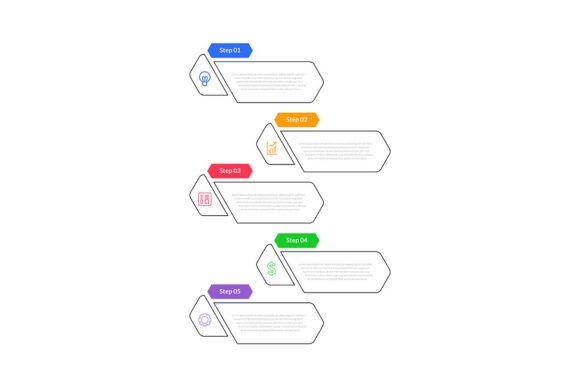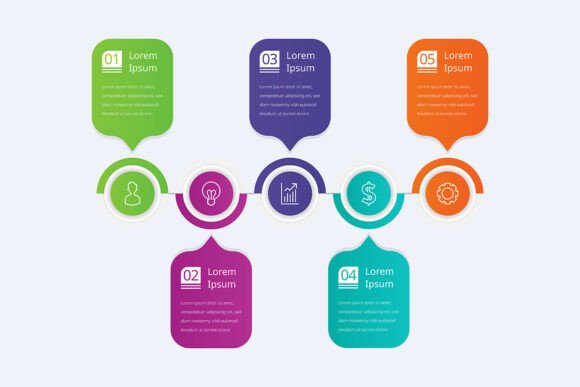
Modern 5-Step Business Infographic
Whether you're launching a startup, refining your operations, or presenting strategy to stakeholders, clear communication is non-negotiable. The Modern 5-Step Business Infographic is designed for exactly that purpose: turning complex processes into intuitive, visually compelling narratives. It’s not just another design asset—it’s a practical tool built around how people actually understand, remember, and act on information.
At its core, this infographic outlines a streamlined, contemporary framework for business progression—think of it as a visual roadmap for growth, transformation, or execution. Unlike generic flowcharts or outdated models, the Modern 5-Step Business Infographic reflects current best practices in strategic planning, customer-centric development, agile iteration, and measurable outcomes. Its structure supports clarity without oversimplification, making it equally valuable for internal alignment and external storytelling.
Why Businesses Struggle with Process Communication
Many teams face recurring challenges that aren’t about lack of knowledge—but about lack of shared understanding. You’ve likely experienced one or more of these:
- Misaligned cross-functional teams—marketing, sales, and product moving in different directions because there’s no unified visual reference for “how we deliver value.”
- Ineffective onboarding—new hires spending weeks deciphering internal jargon instead of grasping the company’s operational rhythm.
- Weak investor or client presentations—dense slides filled with text that fail to convey momentum, logic, or differentiation.
- Stagnant improvement cycles—teams stuck in reactive mode because they lack a simple, repeatable model to assess where they are and what comes next.
These aren’t technical problems—they’re communication gaps. And when communication falters, decisions slow down, buy-in erodes, and execution suffers.
How the Modern 5-Step Business Infographic Bridges Those Gaps
This isn’t a theoretical diagram. It’s engineered for real-world use—starting with its fully editable template format. Because every business is unique, the Modern 5-Step Business Infographic arrives ready for customization: swap icons, adjust colors, update labels, or re-sequence steps to match your actual workflow—not an idealized version of it.
The high-resolution EPS and JPEG files ensure versatility. Use the EPS for print materials like pitch decks or workshop handouts where crisp vector scaling matters. Use the JPEG for digital platforms—website banners, social media posts, or intranet dashboards—without worrying about pixelation or load time. And because it’s built in RGB color mode, what you see on screen matches what appears across devices and digital channels.
More importantly, the five-step structure itself invites action. Rather than abstract phases like “analyze” or “implement,” each step is outcome-oriented and grounded in modern business thinking—for example, steps may include Define Customer Need, Validate Assumptions Rapidly, Build Minimum Viable Offering, Measure Impact & Iterate, and Scale With Feedback Loops. This makes it easy to map existing initiatives—or spot where assumptions have gone untested.
Practical Applications Across Roles and Contexts
Different users engage with the Modern 5-Step Business Infographic in ways that reflect their goals and constraints:
- Founders and CEOs use it to clarify their go-to-market narrative—not just for investors, but for hiring key talent. A single slide built from this template often replaces three pages of dense executive summaries.
- Marketing and Sales Leaders adapt the steps to visualize the buyer journey—from awareness to advocacy—then align campaigns, content, and KPIs to each stage.
- Operations and Project Managers treat it as a lightweight process audit tool. They overlay current workflows onto the five steps to identify bottlenecks, redundancies, or missing feedback mechanisms.
- Educators and Trainers embed it into curriculum design, using each step as a module anchor—helping learners connect theory to tangible application.
One midsize SaaS company reduced internal alignment meetings by 40% after adopting a customized version of the Modern 5-Step Business Infographic as their quarterly planning backbone. Teams no longer debated *what* to prioritize—they debated *how well* each initiative advanced a specific step. That shift alone accelerated decision-making and improved cross-departmental trust.
Getting Started—Without Overcomplicating It
You don’t need design expertise to benefit from the Modern 5-Step Business Infographic. Start small:
- Identify one recurring friction point—e.g., “Our product launch cycle takes too long.”
- Map your current process onto the five steps—where do delays happen? Where are assumptions unverified?
- Edit just two elements: rename one step to reflect your language (e.g., “Validate Assumptions” → “Test With Real Users”), and add one metric beside it (e.g., “Time to first user feedback: 72 hours”).
- Share it—visually, not verbally. Post it in your team channel. Print it for your next sprint review. Let the diagram do the heavy lifting.
That’s how clarity begins—not with perfect execution, but with shared reference points. The editable nature of the template means iteration is built in. Your first version doesn’t need to be final; it just needs to be *used*.
What to Keep in Mind When Adapting It
While flexibility is a strength, effectiveness depends on thoughtful adaptation. Avoid these common pitfalls:
- Overloading steps with sub-bullets—the power lies in simplicity. If a step needs more than three supporting actions, consider whether it belongs in a separate supporting document—not the infographic.
- Ignoring audience context—a version for investors should emphasize traction and scalability; one for engineers might highlight feedback loops and test metrics. Tailor tone and emphasis—not just text.
- Forgetting color psychology—since the file uses RGB mode, leverage accessible contrast and intentional hues. Blue conveys trust, green signals growth, orange suggests action. Use them deliberately, not decoratively.
- Treating it as static—review your adapted version quarterly. Does it still reflect how work actually happens? If not, revise it. A living infographic stays relevant.
Remember: the goal isn’t to make something “look professional.” It’s to create a shared lens—one that helps your team move faster, communicate clearer, and build with intention.
When you choose the Modern 5-Step Business Infographic, you’re choosing a tool rooted in how people learn, decide, and collaborate—not in how software exports files or designers arrange shapes. It’s ready when you are: high-resolution, editable, and built for impact—not decoration.