Why the Modern 4-Step Business Infographic Is a Game-Changer for Communicating Strategy
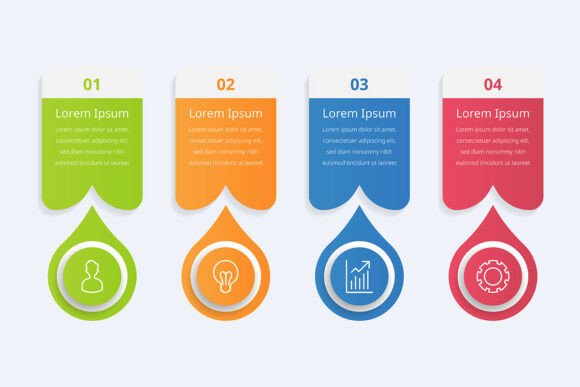
Clarity doesn’t happen by accident—it’s designed. In today’s fast-paced business environment, where attention spans shrink and decision windows narrow, how you present ideas matters as much as the ideas themselves. That’s where the Modern 4-Step Business Infographic steps in—not as decoration, but as a strategic communication tool engineered for impact.
What Makes This Infographic More Than Just a Pretty Graphic?
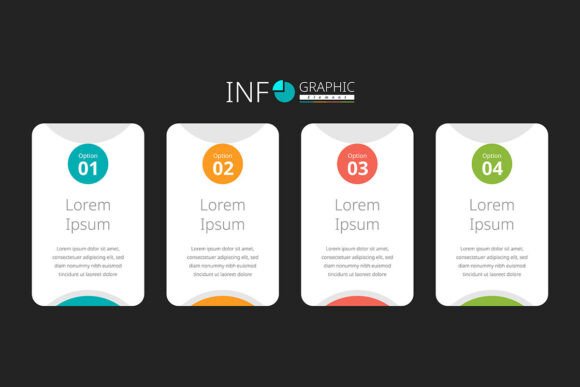
At first glance, it’s clean, balanced, and visually intuitive—four distinct stages arranged in a logical, progressive flow. But its real strength lies beneath the surface: every element serves a functional purpose. The layout isn’t arbitrary. It mirrors how people actually process business concepts—starting with context, moving through action, building toward outcome, and landing on value or next steps. This aligns with cognitive load theory: fewer mental jumps mean faster comprehension.
Unlike generic templates that force content into rigid shapes, this Modern 4-Step Business Infographic is built for flexibility. Each step has clearly defined zones—space for concise headlines, brief supporting text, and visual cues like icons or subtle directional lines. That structure encourages discipline in messaging: no room for jargon, no space for vague claims. You’re guided to say what matters—and only what matters.
Fully Editable Template: Control Without Compromise
“Fully editable” isn’t just marketing language here—it means real control. Whether you’re using Adobe Illustrator, Affinity Designer, or even recent versions of CorelDRAW, the EPS file retains full vector scalability and layer integrity. Text remains live and reflowable. Colors are easily swapped using swatch panels. Shapes resize without pixelation. Icons can be replaced, rearranged, or recolored in seconds.
This level of editability transforms the template from a static asset into a living component of your workflow. Imagine revising a client proposal at 3 p.m. on a Friday—you don’t rebuild from scratch. You open the Modern 4-Step Business Infographic, adjust the second step to reflect updated KPI targets, swap one icon for a more industry-specific symbol, and export a fresh version before your 4 p.m. call. No design debt. No delays.
High-Resolution Files, Ready to Use—No Rendering Required
There’s no “almost ready” with this package. You get production-grade files—immediately. The included JPEG is not a web preview; it’s a high-resolution (300 DPI), RGB-mode image sized for print-ready brochures, pitch decks, trade show banners, or digital signage. It loads fast, displays crisply on Retina screens, and integrates seamlessly into PowerPoint, Keynote, or Google Slides without compression artifacts.
That readiness saves time across teams. Marketing doesn’t wait for design to finish tweaking exports. Sales drops the JPEG into their CRM presentation library and shares it with prospects in under a minute. Training departments embed it directly into LMS modules—no IT approval needed for custom fonts or missing assets. The Modern 4-Step Business Infographic removes friction between concept and delivery.
EPS + JPEG Combo: Flexibility Meets Practicality
The dual-format inclusion—EPS and JPEG—isn’t redundancy. It’s thoughtful coverage for real-world use cases.
- EPS gives designers and agencies full creative control: editing paths, adjusting gradients, integrating with brand guidelines, prepping for offset printing, or exporting to SVG for web animations.
- JPEG serves everyone else: project managers pasting into status reports, consultants embedding in client emails, educators uploading to learning platforms, or startup founders updating investor decks on the go.
And because both files use RGB color mode, they’re optimized for digital-first workflows—screens, presentations, websites, social media—without unexpected shifts in tone or contrast. No surprise magenta when you thought you picked navy. No dulling of accent colors on mobile devices. What you see in your editor is what your audience sees.
Where This Infographic Fits Naturally Into Real Workflows
You’ll find the Modern 4-Step Business Infographic thriving wherever clarity accelerates decisions:
- Product launches: Map the journey from discovery → validation → build → launch—each step anchoring a milestone, metric, or team responsibility.
- Process improvement initiatives: Visualize current state → pain points → solution design → implementation roadmap—making abstract change tangible for cross-functional stakeholders.
- Client onboarding: Replace dense PDF checklists with four clear phases: welcome & scope → setup & access → training & support → review & refine.
- Sales enablement: Turn complex solution architectures into digestible sequences—e.g., assess → customize → integrate → optimize—so reps confidently explain value at each stage.
It’s especially powerful in hybrid or remote settings. A well-designed infographic reduces misalignment caused by fragmented Slack messages or incomplete meeting notes. Shared visuals become common reference points—“Remember Step 3 from the onboarding graphic? That’s where we’ll add the compliance checklist.”
Practical Considerations Before You Choose—or Customize
Before dropping this into your next project, ask yourself a few grounded questions:
- Does your message genuinely follow a four-stage logic? Forcing unrelated concepts into four boxes dilutes impact. If your process has five core phases—or just two—this may not be the right fit. Honesty about structure leads to better communication.
- Who’s your primary audience? Executives often prefer minimal text and strong visual hierarchy. Technical teams may want embedded metrics or data callouts. The Modern 4-Step Business Infographic supports both—but only if you tailor the content deliberately.
- Will it live digitally, in print, or both? Since the JPEG is RGB and high-res, it’s ideal for screen use and digital printing. For large-format offset printing (e.g., conference backdrops), confirm with your printer whether RGB-to-CMYK conversion is handled in-house—or request a CMYK version if needed.
- How much brand integration do you need? The template uses neutral, professional typography and spacing—designed to accept your logo, primary colors, and font pairings without visual conflict. Test early: drop in your brand palette, then step away for 10 seconds. Does it still feel cohesive—or does something clash?
Real-World Examples That Show Its Range
A SaaS company used the Modern 4-Step Business Infographic to simplify their customer success journey: Activate → Adopt → Expand → Advocate. They added micro-icons (a gear, a user avatar, a growth chart, a testimonial quote) and linked each step to a specific CSM touchpoint. Result? Onboarding email open rates increased 22%, and support ticket volume dropped 17% in Q3.
An architecture firm repurposed the same template—not for internal process, but for client education: Discover Vision → Develop Concept → Refine Details → Deliver Reality. They embedded small site photos in each step and used subtle line weight changes to imply progression. Clients reported feeling “more confident about the timeline” and asked fewer “where are we now?” questions.
Even nonprofits have adopted it—not for fundraising pipelines, but for community engagement: Listen → Collaborate → Act → Reflect. The visual rhythm reassured partners that participation wasn’t transactional, but cyclical and values-driven.
Final Thought: Design That Works for People, Not Just Pixels
The Modern 4-Step Business Infographic succeeds because it respects two truths: people need simplicity to act, and professionals need precision to execute. It bridges that gap—not with clever effects or flashy transitions, but with intelligent structure, editable fidelity, and immediate usability. When your goal is to make strategy visible, memorable, and actionable, this isn’t just another template. It’s a quiet multiplier—one that earns its place in decks, dashboards, and daily decisions.