Untact Economy Icon Set 6
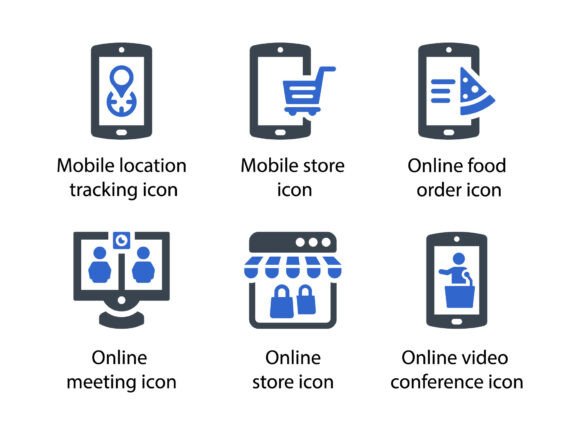
The Untact Economy Icon Set 6 is a curated collection of 7 meticulously designed glyph-style icons representing core digital services that emerged or accelerated during the shift toward contactless interaction. Each icon—Location tracking, Mobile store, Food order, Online meeting, Online store, Video conference—is crafted with visual consistency, scalability, and functional clarity in mind. Delivered in EPS, SVG, and PNG formats, the set supports both vector-based workflows and raster-dependent use cases across web, print, and presentation environments.
Designers, developers, and content creators evaluating icon resources often prioritize reliability, adaptability, and contextual relevance. The Untact Economy Icon Set 6 responds to these needs by focusing on a specific thematic domain: services enabling remote engagement, transaction, and coordination. Unlike general-purpose icon libraries, this set deliberately narrows scope to reflect common touchpoints in today’s digital economy—making it especially useful when coherence around “untact” functionality matters more than broad stylistic variety.
One reason someone might consider this set is consistency of intent. Glyph icons rely on clean lines, balanced negative space, and minimal detail to convey meaning at small sizes. These icons avoid decorative flourishes or realism, favoring legibility across devices and contexts. For example, the Online meeting and Video conference icons share structural logic—both use simplified screen-and-camera motifs—but remain distinct through subtle differences in framing and symbol placement. That level of intentional differentiation supports intuitive recognition without requiring labels in many interface layouts.
Another practical benefit lies in format flexibility. The inclusion of EPS files ensures compatibility with legacy print production tools, while SVG files support responsive web implementation—including CSS-driven color changes and accessibility enhancements via proper title and desc attributes (though users must implement those manually). PNG files are provided in multiple resolutions, facilitating quick integration into slide decks or social media graphics where vector editing isn’t feasible. This multi-format delivery reduces friction for teams working across disciplines and toolchains.
However, tradeoffs exist. Because the set contains only seven icons, it does not serve as a comprehensive solution for projects requiring broader symbolic coverage—such as finance, healthcare, education, or logistics domains. Users needing icons for user authentication, payment processing, notifications, or data visualization will need to supplement with other assets. Additionally, the glyph aesthetic prioritizes neutrality over personality; if a brand relies on expressive, illustrated, or hand-drawn iconography to reinforce voice or tone, this set may feel too restrained.
Color treatment is another consideration. The icons are delivered in monochrome (typically black or white outlines), which supports easy recoloring but requires deliberate planning for contrast, accessibility, and visual hierarchy. Designers must verify sufficient luminance contrast against background colors—especially in UI components—and ensure SVG implementations include appropriate ARIA attributes for screen readers. While technically straightforward, these steps demand attention beyond simple drag-and-drop usage.
The Untact Economy Icon Set 6 is a strong fit for specific scenarios. It works well in dashboards or admin panels where users interact repeatedly with location, ordering, and virtual collaboration features. Its clarity benefits infographics comparing service models (e.g., “in-store vs. mobile store”) or presentations outlining digital transformation roadmaps. It also suits printed reports or investor materials focused on e-commerce adoption, remote work infrastructure, or smart city initiatives—contexts where thematic alignment strengthens message cohesion.
Similarly, development teams building MVP interfaces for food delivery apps, telehealth platforms, or hybrid event management tools may find value in using these icons as placeholders or final assets—particularly when time is constrained and visual fidelity must remain high across breakpoints. Because each icon scales cleanly, they integrate predictably into CSS Grid or Flexbox layouts without pixelation or layout shifts.
Conversely, alternatives may be preferable in other situations. If a project demands full icon system coverage—including states (e.g., disabled, loading), variants (filled vs. outlined), or language-specific glyphs—the Untact Economy Icon Set 6 falls short by design. In such cases, scalable icon frameworks like Tabler Icons, Lucide, or Material Symbols offer wider breadth, active maintenance, and community documentation. Likewise, custom illustration-based icon sets better suit brands seeking distinctive visual identity or narrative depth—something glyph icons intentionally avoid.
Cost and licensing are also relevant considerations. While pricing details aren’t part of this evaluation, users should verify usage rights for their intended context—especially for commercial applications involving redistribution (e.g., SaaS platforms embedding icons into white-labeled interfaces) or derivative works. Some icon licenses restrict modification or require attribution; others permit bundling with software. Reviewing the license terms before integration avoids downstream complications.
Practical decision-making starts with clarifying goals. Ask: Is the priority speed and thematic precision—or long-term extensibility? Does the project center on untact service patterns, or does it span multiple operational domains? Will icons appear primarily in static documents, dynamic web interfaces, or embedded hardware displays? Answering these helps determine whether the focused utility of the Untact Economy Icon Set 6 aligns with actual requirements—or whether a broader, more modular resource would reduce future iteration effort.
Also consider team workflow. If designers rely heavily on Figma or Sketch libraries with auto-layout and variant support, a standalone icon set without built-in component structures may require additional setup. Conversely, developers integrating icons directly into React or Vue components may appreciate the simplicity of individual SVG files—no dependency bundling or icon-font loading delays.
Finally, evaluate against existing assets. If a brand already uses a custom icon system, adding just seven externally designed glyphs risks visual fragmentation unless careful alignment is made in stroke weight, corner radius, and optical sizing. In those cases, adapting internal guidelines to produce new icons—or commissioning a targeted extension—may yield stronger results than mixing sources.
In summary, the Untact Economy Icon Set 6 serves a defined purpose: delivering clear, scalable, thematically unified glyphs for key contactless interactions. Its strength lies not in universality but in focus. Readers evaluating icon solutions should weigh that focus against their project’s scope, timeline, technical constraints, and long-term maintenance needs—not whether the set is “good,” but whether it solves the right problem, in the right way, for their specific context.