Untact Economy Icon Set 7: Precision Glyph Icons for Modern Digital and Print Workflows
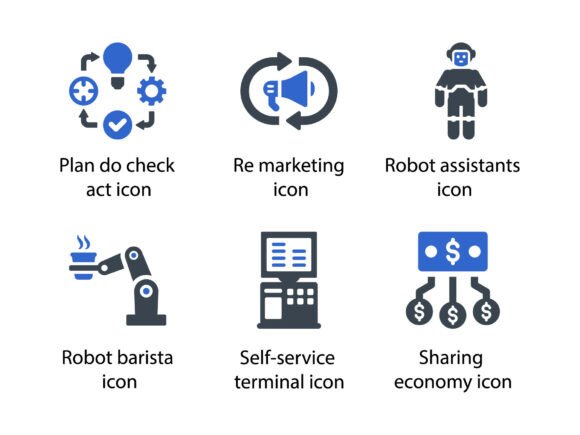
Untact Economy Icon Set 7 is a curated collection of 28 meticulously designed glyph icons that visually articulate the core concepts driving today’s contactless, automated, and platform-based economic systems. Unlike generic icon libraries, this set was built with intentionality—each symbol reflects real-world touchpoints like robot baristas, self-service terminals, sharing economy platforms, and re-marketing pipelines. It bridges conceptual clarity with technical readiness: every icon ships in EPS, SVG, and PNG formats, ensuring compatibility across design tools, development environments, print production, and presentation software.
Where This Set Fits in Your Workflow
Icons are rarely used in isolation—they’re embedded in processes. Untact Economy Icon Set 7 functions best when treated as a consistent visual language layer, not just decorative assets. For example, during the planning phase of a SaaS dashboard redesign, designers use the “robot assistants” and “self-service terminal” icons to map user journey touchpoints before writing a single line of code. In execution, developers pull the SVG files directly into React components or CSS background declarations, preserving scalability and reducing HTTP requests. During review and iteration, stakeholders recognize intent instantly—the “sharing economy” icon signals peer-to-peer interaction logic; the “re-marketing” glyph clarifies retargeting flows without requiring lengthy annotations.
This set doesn’t replace strategy—it sharpens it. When educators build digital literacy modules on automation trends, pairing the “robot barista” icon with a case study on AI-driven service delivery creates immediate cognitive alignment. Marketers embedding these icons into campaign infographics don’t just illustrate ideas—they reinforce thematic consistency across email, landing pages, and printed brochures.
Practical Integration Across Tools and Teams
Compatibility is built into the file structure. The EPS files support high-resolution offset printing for conference banners or investor pitch decks. SVGs scale cleanly in Figma, Adobe XD, and web builds—no pixelation, no manual resizing. PNG variants (with transparent backgrounds, at 256px, 512px, and 1024px) slot seamlessly into PowerPoint slides, Notion dashboards, or social media templates where vector support is limited.
For teams using design systems, Untact Economy Icon Set 7 integrates cleanly. Its monoline 2px stroke weight, uniform 4px corner radius, and centered baseline align with modern UI frameworks like Material Design and Apple’s Human Interface Guidelines. No visual dissonance arises when pairing its “plan-do-check-act” cycle icons with existing status indicators or navigation elements. That consistency reduces cognitive load for users and accelerates team alignment during handoff.
Freelancers and small agencies benefit most from the cross-format efficiency. A single client request—a responsive e-commerce site highlighting post-purchase re-marketing options—can be addressed by dropping the re-marketing icon into a Figma wireframe, exporting the SVG for the front-end dev, and repurposing the same asset in a PDF proposal. No recreation. No version drift. No licensing ambiguity.
Preparation Matters: Organize Before You Use
Before importing icons into a project, spend five minutes organizing them. Create a naming convention that mirrors your workflow: untact-robot-barista-svg, untact-sharing-economy-png-512. Store them in a dedicated folder inside your project’s /assets/icons/ directory—not nested three levels deep in legacy downloads. This prevents duplication and makes future updates faster. If you’re managing multiple clients, consider a lightweight internal style guide page noting which icons map to which business concepts (e.g., “‘Self-service terminal’ = kiosk UX flow; never used for mobile app login”)
Workflow Examples You Can Adapt Today
- Product Launch Prep: Use the “robot assistants” and “re-marketing” icons side-by-side in a go-to-market slide deck to clarify how AI support and behavioral targeting work together—not as separate features, but as coordinated layers of customer engagement.
- Educational Content Creation: Build a printable one-pager on the untact economy for small business owners. Layer the “sharing economy”, “self-service terminal”, and “plan-do-check-act” icons over concise explanations. Print-ready EPS ensures crisp output on letterhead or trade show handouts.
- Internal Process Mapping: Document a new customer onboarding flow in Miro or FigJam. Replace generic arrows and boxes with Untact Economy Icon Set 7 glyphs—“robot barista” for automated welcome emails, “sharing economy” for community referral steps, “check” from the PDCA sequence for QA checkpoints. Visual precision cuts meeting time by clarifying scope upfront.
Quality Control and Long-Term Usability
These icons were designed for longevity—not trend-chasing. There are no gradients, shadows, or exaggerated skeuomorphism. The glyph style prioritizes legibility at small sizes (16px in UI toolbars) and impact at large scales (300mm banners). That balance means they won’t look dated in 18 months. When updating brand assets, you won’t need to relicense or redraw—just adjust color fills via CSS variables or global swatches in Illustrator.
Consistency checks are simple: open all SVGs in a text editor and verify each uses the same viewBox="0 0 24 24". That uniformity guarantees predictable spacing, alignment, and responsive behavior. If your team uses icon fonts, convert the SVGs using IcoMoon or Fontello—but only if necessary. Native SVG usage remains the most maintainable path for most modern projects.
Real Decisions, Not Just Assets
Choosing Untact Economy Icon Set 7 isn’t about acquiring files—it’s about selecting a shared vocabulary. When a marketer, developer, and content strategist all recognize the “self-service terminal” icon as representing reduced human-touch support pathways, miscommunication drops. When an educator uses the “robot barista” icon to spark discussion about labor transition—not as a gimmick, but as a concrete reference point—learning becomes grounded.
It also informs purchasing decisions. If your current icon library lacks symbols for automation or platform economics, patching in mismatched assets creates visual fragmentation. Untact Economy Icon Set 7 closes that gap deliberately. And because it includes both conceptual icons (“sharing economy”) and operational ones (“re-marketing”), it supports communication across strategic and tactical layers of work.
For creators balancing speed and fidelity, this set delivers both: drag-and-drop usability without sacrificing nuance. For teams documenting complex systems, it adds clarity without oversimplification. For anyone translating abstract economic shifts into tangible design or communication artifacts, it provides the right visual shorthand—accurate, adaptable, and ready to use.