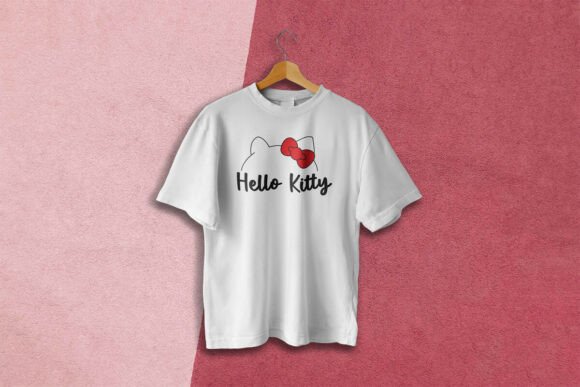
Cute Kitty with Red Bow T-Shirt Design
Minimalist design assets like the Cute Kitty with Red Bow T-Shirt Design serve a quiet but critical role in creative workflows—especially for professionals who juggle multiple output formats, tight deadlines, and brand-consistent deliverables. This isn’t just another clipart file. It’s a precision-crafted vector silhouette: a clean cat head outline paired with a bold, centered red bow. Its simplicity is intentional—not for lack of detail, but for maximum adaptability across physical and digital outputs.
Where This Design Fits in Your Creative Process
The Cute Kitty with Red Bow T-Shirt Design typically enters your workflow at the *asset selection* or *template customization* stage—not at ideation, and rarely at final delivery. You’ve already decided on a theme (e.g., “kitten-themed birthday party”), identified your audience (e.g., preschool-aged kids or parents planning crafts), and selected your production method (e.g., heat transfer vinyl on cotton tees, printable party banners, or iron-on patches). At that point, this design functions as a ready-to-deploy visual anchor: consistent, scalable, and production-ready.
It bridges the gap between conceptual intent and tangible execution. Unlike hand-drawn illustrations or layered PNGs, its vector foundation means it scales to 3 inches for a onesie appliqué or 24 inches for a classroom door decoration—without pixelation or manual redrawing. That fidelity saves time during prep, reduces revision cycles, and supports consistency across touchpoints (e.g., matching t-shirts, cupcake toppers, and thank-you cards all using the same bow placement and proportion).
Integration Across Tools and Platforms
This design is built for compatibility—not just with cutting machines like Cricut and Silhouette, but with broader ecosystem tools you already use. SVG files import cleanly into Canva for quick social media graphics, Adobe Illustrator for batch resizing and color variants, and even Microsoft PowerPoint for editable classroom visuals. If you’re using Printful or Gelato for print-on-demand, the high-contrast black-and-red palette ensures crisp reproduction on light and medium fabrics without color correction overhead.
For educators and small business owners, integration extends beyond software. The design works within existing supply chains: it pairs reliably with standard 600–800 gsm cardstock for die-cut decorations, HTV rolls in matte red and black, and sublimation blanks designed for crisp line art. No special ink profiles or calibration steps are needed—just upload, size, and cut or print.
Practical Implementation Tips for Real Workflows
Preparation matters more than you think. Before importing the Cute Kitty with Red Bow T-Shirt Design into your machine software, check its layer structure. A well-built version separates the bow and head outline as independent paths—giving you flexibility to recolor, resize, or omit one element without affecting the other. If your file doesn’t offer that, spend five minutes ungrouping and labeling layers in Illustrator or Inkscape. It pays off when you need a bow-only version for hair clips or a head-only version for monochrome embroidery.
Batch processing saves hours. If you’re producing 30+ items—say, custom t-shirts for a daycare staff appreciation day—use the “copy-paste-repeat” function in Cricut Design Space or Silhouette Studio to duplicate the design across a mat grid. Then adjust only the material settings once (e.g., “Iron-On Lite” or “Cardstock – Heavy”) rather than reconfiguring per item. That single setting change eliminates inconsistency in cut depth and pressure.
Test before you commit. Always run a test cut on scrap material—even if you’ve used the design before. Machine calibration shifts over time, and environmental factors (humidity, blade wear, material batch variance) affect edge sharpness. A 2-inch test cut reveals whether the bow’s curves hold definition or blur into soft edges. Adjust blade force by ±0.5 if needed, then proceed.
Workflow Example: Birthday Party Kit Production
A freelance party planner uses the Cute Kitty with Red Bow T-Shirt Design as the centerpiece of a DIY kit sold to clients. Her process:
- Week 3 before event: Imports the SVG into Silhouette Studio, resizes the cat head to 4.5" wide for t-shirts and 1.75" for favor tags, then exports both as separate SVGs.
- Week 2: Cuts HTV for 12 t-shirts (using mirrored cut), then cuts cardstock for 40 favor tags and 8 banner letters—all from the same original file, no redesign.
- Week 1: Assembles kits with pre-cut pieces, printed instructions, and fabric glue dots—no client-side design decisions required.
The design doesn’t replace her expertise—it structures it. Clients get predictability; she gets repeatability.
Long-Term Usability and Quality Control
Over time, the value of this design compounds—not because it’s trendy, but because it’s stable. Unlike photorealistic or heavily stylized cat art, the minimalist silhouette avoids dated trends (e.g., exaggerated eyes or pastel gradients). It remains legible at small sizes, readable in low-resolution prints, and recognizable across age groups. That longevity supports reuse across seasons, events, and product lines.
For quality control, treat the design like a core brand asset. Store it in a clearly labeled folder (“Design Assets > Silhouettes > Cute Kitty Red Bow”) with version notes (e.g., “v2.1 – bow path simplified for cleaner cut”). If you modify it—say, adding a subtle shadow for a specific project—save the variant separately. Never overwrite the original. Consistency across projects depends on having one trusted source file.
Organizing for Efficiency and Team Handoff
If you collaborate—whether with a VA handling Etsy listings, a printer managing bulk orders, or a co-teacher preparing classroom materials—clarity around file usage prevents miscommunication. Include a brief README text file with your download that specifies:
- Recommended minimum size (1.25” width for fine-detail applications)
- Optimal file format per use case (SVG for cutting, PNG @300dpi for print, PDF for vendor handoff)
- Color-safe zones (e.g., “Red bow must remain solid #E31937 for brand alignment”)
- Prohibited edits (e.g., “Do not stretch proportions—maintain 1:1 aspect ratio for head outline”)
This level of documentation turns a simple graphic into a shared, maintainable resource—not a one-off decoration.
When to Choose This Over Other Cat Designs
You’ll reach for the Cute Kitty with Red Bow T-Shirt Design when clarity, speed, and cross-format reliability outweigh novelty. It’s the right choice if:
- Your priority is getting clean cuts on budget-friendly materials—not chasing artistic uniqueness
- You need identical visual treatment across apparel, paper goods, and digital invites
- You’re supporting others (clients, students, team members) who need foolproof, no-learning-curve assets
- You’re building a repeatable product line where recognizability matters more than seasonal variation
It’s not about limiting creativity. It’s about removing friction so creativity can focus where it counts—on personalization, storytelling, and human connection—not troubleshooting jagged bow edges or mismatched scaling.
In practice, the Cute Kitty with Red Bow T-Shirt Design earns its place not by standing out alone, but by enabling everything else to work smoothly around it.